
Jaipur • New Delhi • Bengaluru • Guwahati • Kolkata
B. K. Nagla | Kameshwar Choudhary (Eds)
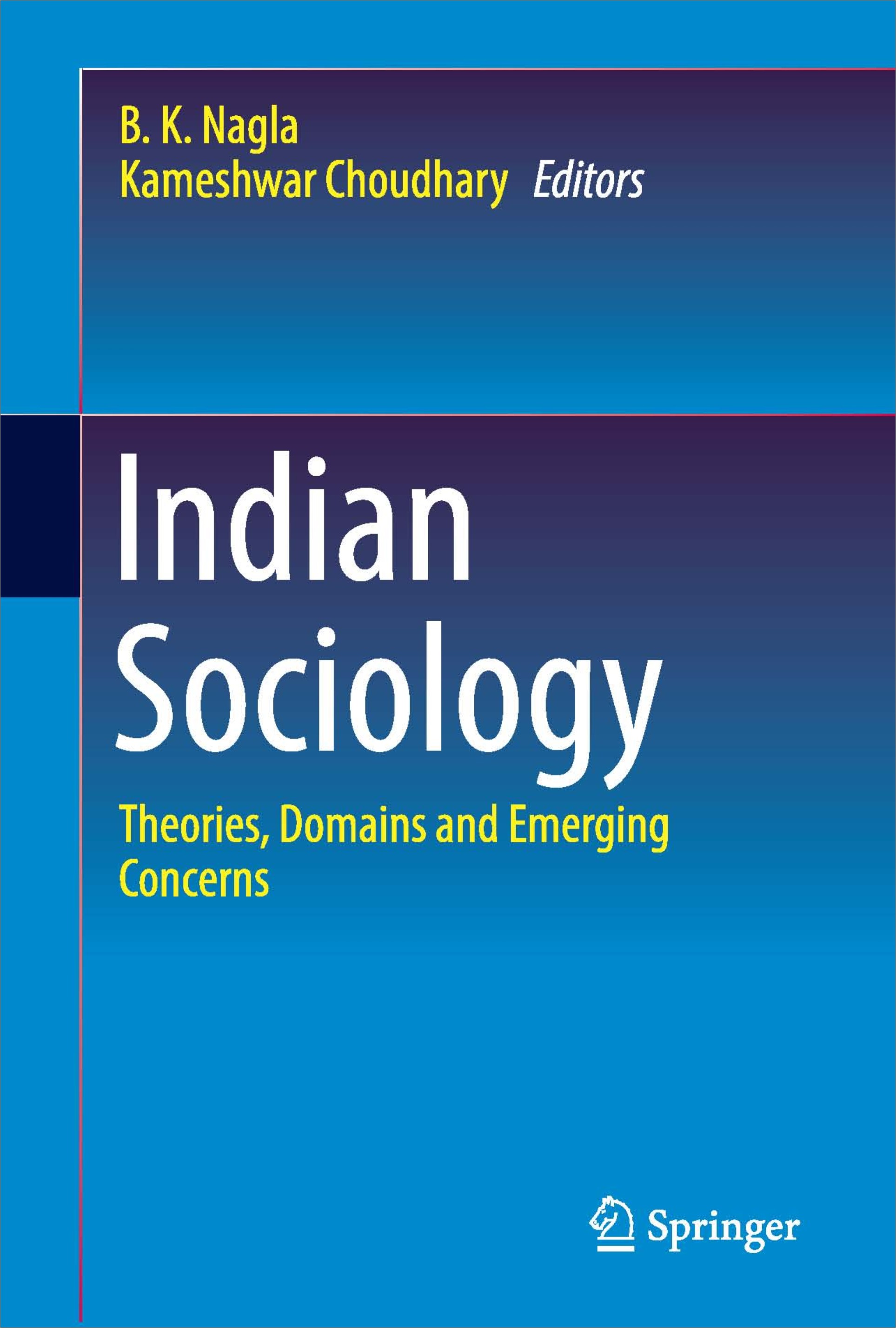
This book presents a critical and reflective view of fundamental
theoretical orientations, thematic domains, and current debates in Indian
sociology. It covers the growth of sociology as an academic and pedagogical subject,
with four main parts. Part I discusses important theoretical orientations in
Indian sociology, including Indological and civilizational approaches, as well
as the contributions of an eminent sociologist and pioneer in Indian sociology,
Professor Yogendra Singh, concerning the sociology of knowledge, liberal
democracy, and the relevance of his concept of Islamization in the study of
Indian society. Part II examines substantive areas of study such as caste,
class, and tribe. Part III reflects on specific topics of current concern in
Indian sociology, such as emerging vistas and futures, globalization, and
rethinking area studies for planetary conversations. This book is highly
relevant for postgraduate students and researchers in sociology, social anthropology,
and social sciences.
1 Introduction
by B. K. Nagla and Kameshwar Choudhary Part I Theoretical Orientations
2 Indology
and Sociology by Pradip Kumar Bose
3 The
Civilizational Approach: Contributions of Surajit Sinha by Biswajit Ghosh
4 A.
K. Saran on Modernity, Indian Tradition and Sociology in India by Ajit Kumar
Pandey
5 Sociology
and Public Life: Professor Yogendra Singh and His Contribution to Liberal
Democracy by Dipankar Gupta
6 Re-visiting
Islamization as a Contribution to Indian Sociology and Yogendra Singh by K. M.
Ziyauddin
7 Exploring
B. R. Ambedkar’s Sociology: A Biographical Approach by Swapan Kumar
Bhattacharyya
Part II Thematic Domains
8 Power
in Caste: The Decline of the Dominant Caste in a Village in Eastern Uttar
Pradesh by Hira Singh
9 Village
Meaning Home: The Exodus from Urban India During the Pandemic of COVID-19 by
Tulsi Patel
10 The
Text and Context of Tribal Studies in India by Vidyut Joshi
11 Changing
Issues in Population Research in India by A. K. Sharma
12 Disability,
Social Inequalities, and Intersectionality in India by Ritika Gulyani and
Nilika Mehrotra
Part III Some Emerging Concerns
13 Orientations
and Futures of Indian and South African Sociologies by Kiran Odhav and
Jayanathan P. Govender
14 Globalization
of Sociology to the Sociology of Globalization by Habibul Haque Khondker
15 Rethinking
and Transforming Area Studies and Indian Studies: A New Cosmopolitanism and the
Challenges of Planetary Realizations by Ananta Kumar Giri
B. K. Nagla is former Professor of Sociology, M.D. University,
Rohtak, Haryana. He obtained his master's degree from Udaipur University,
Udaipur, and M.Phil. and Ph.D. from Jawaharlal Nehru University, New Delhi.
Before joining at M.D. University, Rohtak, in 1978, he taught at M.S.
University, Baroda, and Institute of Criminology and Forensic Science, New
Delhi. After retirement in 2006, he worked as Consultant at Kota Open
University and also at Banaras Hindu University as Professor, Babu Jagjivan Ram
Chair. Professor Nagla has published 12 books in areas like political
sociology, Indian sociological thought, and social strati?cation. His main
books are: Factionalism, Politics and Social Structure; Political Sociology;
Development and Transformation; Social Strati?cation and Social Mobility; and
Indian Sociological Thought. He has about 70 research papers in national and
international journals. He received an ISC Fellow Award for the growth
anddevelopment of the Indian Society of Criminology given by the Council of the
Indian Society of Criminology, af?liated with the International Society of
Criminology, Paris. In 2017, Sulabh International Social Organization conferred
upon him 'Sulabh Swachhata Samman' with Gold Medal for authoring an outstanding
book, Sociology of Sanitation. He is awarded Lifetime Achievement Award by
Rajasthan Sociological Society and also by the Indian Sociological Society. He
was also the editor of the Indian Sociological Society Journal (Hindi),
Bhartiya Samajshastra Sameeksha (published by Sage). Kameshwar Choudhary is former Professor of Sociology, Babasaheb
Bhimrao Ambedkar (Central) University, Lucknow, India. Earlier, he was
Professor of Sociology at Banaras Hindu University, Varanasi; Associate
Professor at Institute of Rural Management, Anand (Gujarat); and Lecturer in
Sociology at Institute of Social Sciences, Agra. He was Visiting Fellow at
CSSS, Jawaharlal Nehru University, New Delhi, and Associate at the Indian
Institute of Advanced Study, Shimla. He completed his M.A., M.Phil., and Ph.D.
studies at CSSS, Jawaharlal Nehru University, New Delhi. He has completed, as
Coordinator/Team Member, about a dozen projects sponsored by National Dairy
Development Board, Gujarat Ecology Commission, Ministry of Rural Development,
Government of India; Forest Department, Government of Gujarat; UNDP, India;
etc. His books have been published by reputed national and international
publishers, which include Globalisation, Governance Reforms and Development in
India (ed., Sage Publications, New Delhi); Intellectuals and Society: A Study
of Teachers in India (Popular Prakashan, Bombay). He has also published several
papers in reputed journals, edited books and articles in newspapers, like The
Times of India and The Hindustan Times. He was Head, Department of Sociology,
and Dean, Ambedkar School of Social Sciences (formerly SAS), B. B. Ambedkar
(Central) University, Lucknow. He was Member of the Twelfth Plan Working Group
on Empowerment of OBCs, DNTs and EBCs, constituted by the Planning Commission,
Government of India. He was honored with Prof. L. P. Vidyarthi Memorial Award
2017 by the Indian Social Science Association (Email: kames.c@gmail.com).



Sukhadeo Thorat and Narender Kumar (Eds.)
Your cart is empty.
